
Trekking in Guyana: A Pristine Jungle Odyssey
- Jungle survival
Table of Contents
Master The Fundamentals That Keep You Alive
There is a moment — usually somewhere around day two on the water — when the Essequibo stops feeling like a destination and starts feeling like a living thing. The jungle closes in on both banks, the WiFi signal dropped out two hours ago, and the only sounds are the paddle dipping into dark water and the distant call of a Scarlet Macaw.
This is what our guides call ‘the shift’ — the point at which every client stops thinking about their inbox and starts paying full attention to what’s in front of them. It’s the reason people come back year after year. Not just for the fish, as spectacular as they are, but for the feeling of total immersion in one of the most extraordinary natural environments on earth.
The Essequibo watershed covers roughly 155,000 square kilometres and contains an estimated 800+ species of freshwater fish — more than the entire continent of Europe. Fishing here isn’t just recreation. It’s a window into an ecosystem that has remained almost unchanged for millions of years.
Master The Fundamentals That Keep You Alive
The Essequibo River stretches over 1,000 kilometres from the Guiana Highlands to the Atlantic Ocean, carving through an almost untouched wilderness that few anglers have ever experienced. Its dark, tannin-rich waters shelter some of the most exciting freshwater species on the planet — from the ferocious Arapaima (one of the world’s largest freshwater fish) to the acrobatic Peacock Bass that will test every aspect of your fishing ability.
Fishing the Essequibo is not just a sport — it’s an expedition. The river system is remote, the jungle is alive around every bend, and the catches here are genuinely world-class. But it requires preparation. The right gear, the right knowledge, and ideally the right local guide can make the difference between an unforgettable adventure and a frustrating (and potentially dangerous) experience.
In this guide, we’ll walk you through everything you need to know: when to go, what to pack, which techniques work best, and how to pick the perfect rod for jungle river fishing. Whether you’re a seasoned angler or just getting started, this is your definitive resource.
Water levels drop significantly during the dry season, concentrating fish in deeper pools and making navigation far easier. Peacock Bass are most aggressive in October and November. Avoid the heavy rainy season (May–July) when river levels can rise 4–6 metres, flooding the banks and making access near impossible.
- Best Time to Visit: October – March (Dry Season)
Water levels drop significantly during the dry season, concentrating fish in deeper pools and making navigation far easier. Peacock Bass are most aggressive in October and November. Avoid the heavy rainy season (May–July) when river levels can rise 4–6 metres, flooding the banks and making access near impossible.
- Permit Required
Water levels drop significantly during the dry season, concentrating fish in deeper pools and making navigation far easier. Peacock Bass are most aggressive in October and November. Avoid the heavy rainy season (May–July) when river levels can rise 4–6 metres, flooding the banks and making access near impossible.
Which Rod Is Right for the Jungle?
We tested all three rod types extensively on the Essequibo. Here’s how they compare for jungle river fishing conditions.
- Feature
- Skill Level Required
- Best Target Species
- Cover Performance
- Casting Accuracy
- Handles Heavy Line
- Tackle Tangle Risk
- Price Range (Entry Level)
- Wild Tales Recs
- Spinning Rod
- Beginner
- Peacock Bass, Payara
- Good
- Good
- Low
- $50 – $150
- Spinning Rod
- Intermediate
- Arapaima, Catfish
- Excellent
- Excellent
- Medium
- $80 – $200
- Fly Rod
- Advanced
- Peacock Bass, Payara
- Poor
- Variable
- High
- $120 – $400
- Fly Rod
- Advanced
- Advanced
- Poor
- Variable
- High
- $120 – $400
Which Rod Is Right for the Jungle?
Master The Fundamentals That Keep You Alive
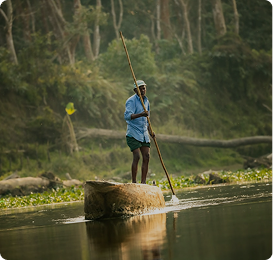
There is a moment — usually somewhere around day two on the water — when the Essequibo stops feeling like a destination and starts feeling like a living thing. The jungle closes in on both banks, the WiFi signal dropped out two hours ago, and the only sounds are the paddle dipping into dark water and the distant call of a Scarlet Macaw.
This is what our guides call ‘the shift’ — the point at which every client stops thinking about their inbox and starts paying full attention to what’s in front of them. It’s the reason people come back year after year. Not just for the fish, as spectacular as they are, but for the feeling of total immersion in one of the most extraordinary natural environments on earth.
The Essequibo watershed covers roughly 155,000 square kilometres and contains an estimated 800+ species of freshwater fish — more than the entire continent of Europe. Fishing here isn’t just recreation. It’s a window into an ecosystem that has remained almost unchanged for millions of years.
You Might Also Like
- Skills & Bushcraft
- 6 min read
- Jungle Equipment
- Jungle Equipment
- 9 min read